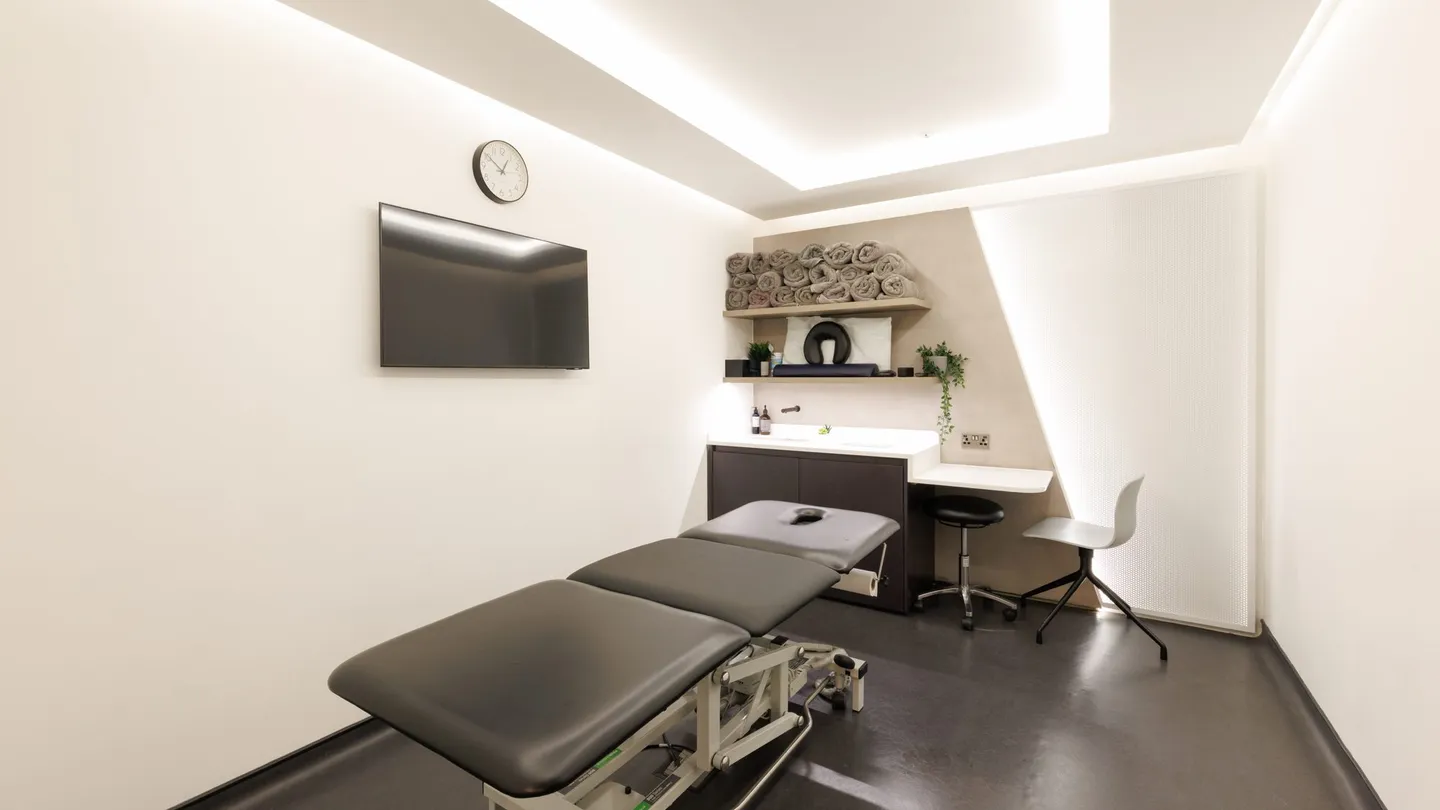
Assessment
A detailed history, then a thorough examination of movement, strength and the affected area. You leave knowing what is wrong, why it happened, and exactly what we are going to do about it.
Exercise rehabilitation in Liverpool Street, London: tailored therapeutic-exercise programmes, designed and progressed by HCPC-registered, CSP-chartered physiotherapists, that rebuild strength, mobility, and confidence after injury, surgery, or persistent pain.


Your first visit is a full musculoskeletal assessment: a detailed history, then testing of movement, strength and the affected area. We explain the working diagnosis in plain English and agree a plan with you before any treatment begins.
You leave with a written summary of what we found and a home exercise programme built around your diagnosis and your goals, so progress keeps going between visits.
Where manual therapy eases symptoms, graded exercise is what restores capacity after injury, surgery, or persistent pain. We rebuild strength, movement, and the confidence to trust the affected area again, progressing the programme as your body adapts.
NICE recommends progressive exercise as a first-line treatment for low back pain, sciatica, and osteoarthritis. Most chronic conditions respond to gradual loading far more than to passive treatment alone, so active rehabilitation sits at the centre of your recovery.
We assess the loads your work, sport, and daily routine place on you, then set clear goals such as lifting a child, returning to running, or getting through a workday pain-free. Every exercise is chosen for your diagnosis and stage, and tracked against those goals.
Both our clinics have full gym facilities. Where regular attendance is difficult, we deliver the same programme as home-based rehabilitation: you are taught each exercise, given clear instructions, and reviewed remotely so your loading progresses safely.
As you near your goals we shift toward independence with a maintenance programme, guidance on managing flare-ups, and a safe return to sport or work. Discharge happens when you have the tools and confidence to keep progressing on your own, not when symptoms first ease.
I saw Amanda for a problem I've been having with a painful shoulder. She explained to me what the problem was, did a thorough treatment session and gave me some exercises to do to improve it. Very professional and friendly, I highly recommend her.
Read on Google
I booked with Michelle for my first appointment. When I stood up I said to her it feels like heaven as my continuous back pain had totally gone. I was totally pain free for 7 hours so bless you Michelle.
Read on Google
I first visited Amanda following a maisonneuve fracture. That day I walked 107 steps in a camboot with two crutches. I have visited weekly. Yesterday I walked 13,315 steps (no crutches, no boot). The transformation is truly amazing.
Read on Google
After my son's sports injury we spent many months trying to get help from various other doctors. It was so reassuring to finally speak with someone who really understood what was going on. Michelle was worth every penny!
Read on Google
Michelle was absolutely amazing during my pregnancy with the multiple issues I had. She diagnosed and treated pain in my knee and my back, and got me from a place where I couldn't kneel at all, to fully weight bearing in a short space of time.
Read on Google
Excellent treatment of my lower back and related sciatica injuries from CrossFit. Definitely my go-to therapist when in dire need of pain relief.
Read on Google

You can refer yourself, with no GP letter needed, and book online in a couple of minutes at whichever clinic is easier for you to reach.
It starts with finding the cause. Whether you are a City professional stuck at a desk or a weekend athlete chasing a comeback, we treat what is driving the problem, then build the strength that keeps it fixed.
A detailed history, then a thorough examination of movement, strength and the affected area. You leave knowing what is wrong, why it happened, and exactly what we are going to do about it.

Manual therapy chosen for your presentation, with Western medical acupuncture added where it helps. Treatment is not the goal in itself: it creates the window to move more freely and load the tissue.

Progressive, coached exercise rehabilitation restores the strength and load tolerance you lost. Both clinics have full gym facilities, and this is the stage that decides whether the fix lasts.

Each follow-up reassesses you against your baseline. We discharge you when you have the strength and the tools to manage on your own, with clinical Pilates and TPI golf screening on hand to keep you moving.
Back to the work, sport and life you love. We settle the pain, get to what is driving it, then rebuild the strength that keeps it away, so you leave each visit a step stronger than the last.


Written and medically reviewed by Amanda Yardley, Physiotherapist & Co-Founder · HCPC-registered · Chartered Society of Physiotherapy · Health and Care Professions Council (HCPC) and Chartered Society of Physiotherapy (CSP).
FAQ
Exercise rehabilitation is a structured, individually prescribed programme designed by a physiotherapist to restore strength, mobility, and function after injury, surgery, or pain. Unlike general training, every exercise is chosen for your diagnosis, stage of recovery, and goals, then progressed safely as your tissues adapt and your capacity returns.
No. UK physiotherapists are first-contact practitioners, so you can self-refer and book directly through our Cliniko online booking: no GP referral is needed. If you are claiming through private health insurance, your insurer may ask for a referral, so check your policy before your first appointment.
Yes. Where regular clinic attendance is difficult, we deliver the same evidence-based programme as home-based rehabilitation. You are taught each exercise, given clear instructions and recordings, and reviewed remotely so your programme is progressed safely. Many patients combine occasional clinic visits with a home-led routine between them.
It depends on the condition and how it responds to loading. Acute injuries often improve over several weeks, while post-surgical or long-standing problems may need a few months of progressive work. Tissue adaptation takes time; we set realistic timelines at your assessment and reassess progress at every review.
Yes, when guided by a physiotherapist who respects your surgeon's protocol. We start within the loading limits set after your operation and progress strength, mobility, and stability in stages as healing allows. This staged approach follows NICE guidance and protects the repair while rebuilding the capacity you need to return to normal activity.
Get Started
The Physio Rooms • 280 Bishopsgate, Liverpool Street, London EC2M 4RB
BookAppointments typically available within 1–2 weeks