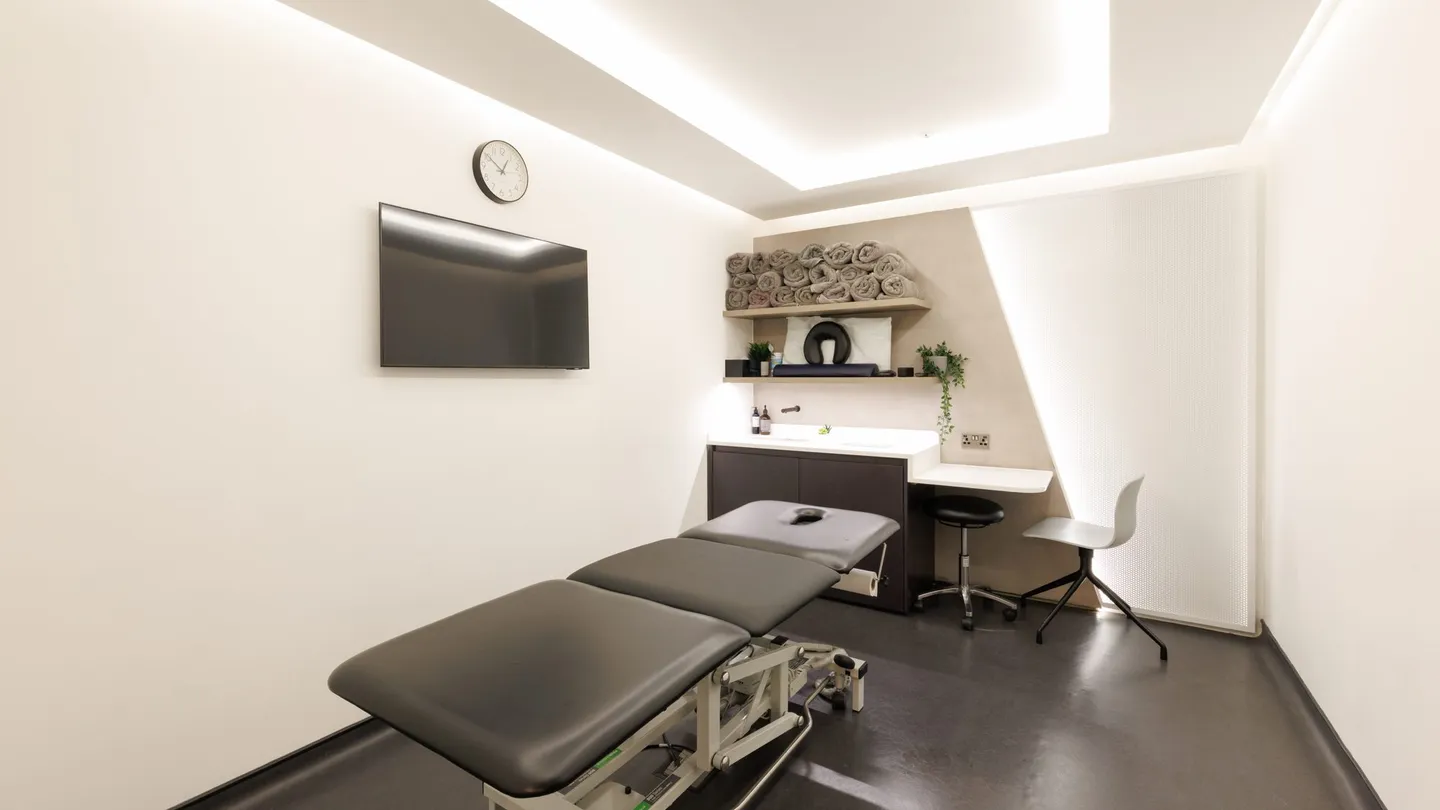
Assessment
A detailed history, then a thorough examination of movement, strength and the affected area. You leave knowing what is wrong, why it happened, and exactly what we are going to do about it.
Assessment and rehabilitation of acute and overuse sports injuries: sprains, muscle and ligament strains, and tissue overload, at our Liverpool Street clinic in the City of London. Returning before the tissue has rebuilt its capacity is one of the most common reasons an injury comes straight back, so we treat sports injuries with graded loading and objective return-to-sport criteria to get you back to your activity, not just out of pain.

Overview
Most sports injuries fall into two groups, and telling them apart shapes the whole plan:
Assessment starts with an accurate diagnosis and a clear picture of what the tissue can currently tolerate. Rehabilitation is then built around progressive, graded loading: we rebuild strength, control, and tolerance step by step through hands-on physiotherapy and structured exercise rehabilitation.
Crucially, we test against return-to-sport criteria, restored strength, symmetry, and sport-specific function, rather than discharging you on how the injury feels. Returning before the tissue has rebuilt its capacity is one of the most common reasons an injury comes straight back, so we get you back to your activity, not just out of pain.
Excellent
From 6 five-star Google reviews
Source: Google
I saw Amanda for a problem I've been having with a painful shoulder. She explained to me what the problem was, did a thorough treatment session and gave me some exercises to do to improve it. Very professional and friendly, I highly recommend her.
I booked with Michelle for my first appointment. When I stood up I said to her it feels like heaven as my continuous back pain had totally gone. I was totally pain free for 7 hours so bless you Michelle.
I first visited Amanda following a maisonneuve fracture. That day I walked 107 steps in a camboot with two crutches. I have visited weekly. Yesterday I walked 13,315 steps (no crutches, no boot). The transformation is truly amazing.
After my son's sports injury we spent many months trying to get help from various other doctors. It was so reassuring to finally speak with someone who really understood what was going on. Michelle was worth every penny!
Michelle was absolutely amazing during my pregnancy with the multiple issues I had. She diagnosed and treated pain in my knee and my back, and got me from a place where I couldn't kneel at all, to fully weight bearing in a short space of time.
Excellent treatment of my lower back and related sciatica injuries from CrossFit. Definitely my go-to therapist when in dire need of pain relief.
Most sports injuries are either acute, from a single event like a sprained ankle or hamstring strain, or from overuse, where load has outpaced the tissue's capacity. We start with an accurate diagnosis and a clear picture of what the tissue can currently tolerate.
Rehabilitation is built around progressive, graded loading: we rebuild strength, control, and load tolerance step by step. This is the stage that most reliably restores capacity and reduces the risk of the injury returning.
We test against return-to-sport criteria rather than discharging on how the injury feels. That means restored strength and symmetry between limbs, good movement control, and the ability to handle sprinting, cutting, jumping, or single-leg load without symptoms.
Complete rest is rarely the right answer. Modified training, reducing intensity and loading around the injured tissue, usually supports recovery better and preserves your fitness. We tell you what to keep doing, what to modify, and what to pause.
For most sports injuries a clinical assessment guides management well, and routine scans often show incidental findings that complicate decisions without changing treatment. Imaging earns its place after significant trauma, with red-flag signs, or when recovery stalls.
Returning before the tissue has rebuilt its capacity is one of the most common reasons an injury comes straight back. We address the strength, mobility, and control deficits up the kinetic chain, so you return to your activity rather than straight back to the clinic.
Why it happens
Acute mechanical overload: a single high-force event such as a sprint, jump landing, change of direction, awkward fall, or contact
Cumulative overuse: training volume or intensity rising faster than the tissue can adapt, driving tendon and bone-stress injuries
Returning to sport too soon after a previous injury, leaving residual weakness or altered movement
Strength, mobility, or control deficits up the kinetic chain (commonly hip, gluteal, calf, or trunk)
Sudden change in footwear, playing surface, or training pattern without an adaptation period
Inadequate warm-up, recovery, or sleep, which lower the tissue's tolerance to load

Your first visit is a full musculoskeletal assessment: a detailed history, then testing of movement, strength and the affected area. We explain the working diagnosis in plain English and agree a plan with you before any treatment begins.
You leave with a written summary of what we found and a home exercise programme built around your diagnosis and your goals, so progress keeps going between visits.
Back to the work, sport and life you love. We settle the pain, get to what is driving it, then rebuild the strength that keeps it away, so you leave each visit a step stronger than the last.


You can refer yourself, with no GP letter needed, and book online in a couple of minutes at whichever clinic is easier for you to reach.
It starts with finding the cause. Whether you are a City professional stuck at a desk or a weekend athlete chasing a comeback, we treat what is driving the problem, then build the strength that keeps it fixed.
A detailed history, then a thorough examination of movement, strength and the affected area. You leave knowing what is wrong, why it happened, and exactly what we are going to do about it.

Manual therapy chosen for your presentation, with Western medical acupuncture added where it helps. Treatment is not the goal in itself: it creates the window to move more freely and load the tissue.

Progressive, coached exercise rehabilitation restores the strength and load tolerance you lost. Both clinics have full gym facilities, and this is the stage that decides whether the fix lasts.

Each follow-up reassesses you against your baseline. We discharge you when you have the strength and the tools to manage on your own, with clinical Pilates and TPI golf screening on hand to keep you moving.

Treatment approach
Hands-on assessment, manual therapy, and a graded loading plan are the core treatment for almost every sports injury, with progress tracked against objective return-to-sport criteria.
See treatment detail →Structured, progressive loading rebuilds strength, control, and tissue tolerance: the stage that most reliably restores capacity and reduces the risk of re-injury.
See treatment detail →Delivered by AACP-trained physiotherapists, acupuncture can be added as an adjunct to help manage pain during the early phases while the active rehabilitation plan does the work.
See treatment detail →FAQ
Complete rest is rarely the right answer. Modified training: reducing intensity, swapping high-impact for low-impact work, and loading around the injured tissue, usually supports recovery better and preserves fitness. Your physiotherapist will tell you what to keep doing, what to modify, and what to pause while the tissue settles and rebuilds.
It depends on the injury. Mild strains and overuse problems often allow modified training within a week and fuller return over several weeks; tendon injuries typically need longer phases of progressive loading. We set a timeline at your first session and update it at each reassessment, based on objective markers rather than guesswork.
We test against return-to-sport criteria rather than discharging on how it feels. That means restored strength and symmetry between limbs, good movement control, and the ability to handle sport-specific demands: sprinting, cutting, jumping, or single-leg load, without symptoms. Skipping these stages is a well-recognised driver of re-injury.
For most sports injuries, no. Clinical assessment usually guides management of soft-tissue injuries well, and routine scans often show incidental findings that complicate decisions without changing treatment. Imaging is appropriate after significant trauma, when red-flag signs are present, or when symptoms do not follow the expected recovery course.
Get Started
The Physio Rooms • 280 Bishopsgate, Liverpool Street, London EC2M 4RB
BookAppointments typically available within 1–2 weeks